Taking a trip away is something we all look forward to. Often serving as the beacon of light at the end of a tunnel teeming with endless responsibilities, travel is universally seen to be a pursuit well worth the time, effort and expense. But what happens when you get to your dream holiday and find yourself too tired to enjoy it to the fullest?
Jet lag has a nasty habit of turning what should be a once-in-a-lifetime experience into something which you occasionally have to power through. For those taking long treks between vastly different timezones, adjusting your body clock can make all the difference when it comes to the overall enjoyability of your time away.
In this data-driven guide, we’re going to take a closer look at what you need to know about jet lag to better understand and, ultimately, beat it. If you’re wondering how to perfectly balance travel, having fun, and getting the optimum amount of sleep while you’re adventuring, be sure to read on.
What is jet lag?
Jet lag (scientifically known as desynchronosis) happens when your internal clock – or "circadian rhythm” – is disrupted as a result of hopping across one or multiple different timezones.
Think of it this way: you take off on a flight from Delhi to Adelaide at 8am your local time. But owing to the time difference (5.5 hours during Adelaide’s daylight savings time between October and April, 4.5 hours for the rest of the year), that means your flight is leaving at 1:30pm in Australia. You arrive at 6:30pm local time but, for you, your internal clock thinks it’s now 1pm. This shift between time zones will leave you groggy and extremely tired – especially if you weren’t able to sleep on the flight.
What causes us to become jet lagged?
As you can imagine, knocking your circadian rhythm out of whack like this can have a huge impact on how awake we feel. Your sleep-wake cycle will struggle to adjust for a short period after travel of this nature, and it can have a wider impact on things like the time of day when you’re hungry, or even when you might need to use the bathroom.
The amount of sunlight we receive also plays a large role in our body’s ability to function properly. Light can regulate a number of hormones inside of us – but arguably the most important of these is a sleep-supporting one known as melatonin.
The more light we experience during the day, the less melatonin we can produce. That means if you are exposed to bright natural (or fake) light for extended periods of time, your body won’t register that it needs to produce the hormone to help you fall asleep.
While less common of a cause, the air pressure inside of a cabin of a plane can also trigger jet lag. Dry air conditions inside the plane will lead to you feeling more dehydrated, which can impact how your body functions.
What are the symptoms of being jet lagged?
Most of us know that jet lag will make us feel a lot more tired when we arrive at our destination. But this is far from the only adverse effect which you might feel. Aside from a feeling of extreme tiredness, other symptoms which have commonly been associated with jet lag are:
Difficulty concentrating
Trouble falling asleep when you try to
Gastrointestinal issues like nausea, indigestion and a change in appetite
Mood shifts and a feeling of being low or easily irritable
The type of jet lag you experience is going to differ depending on whether you travel east (where you gain hours) or west (where you lose them).
Losing hours might mean that you find it tough to fall asleep, as you try to adjust to a new schedule. Gaining hours might make it harder to stay awake during the day, as this could be a time when your body would normally be asleep.
25+ important facts about the impact of jet lag and its relationship with sleep
Now that we have a better understanding of what jet lag is and how it might impact someone on their travels, it’s time to take action. The best way to do that is by understanding the nuances of this pesky flying phenomenon. Let’s dive into these eye-opening facts to make getting your head around jet lag a breeze.
1. Jet lag can start before you fly
Kicking things off with something less fun, research from the NUS Yong Loo Lin School of Medicine shows that jet lag symptoms can actually begin to surface before you step on a plane. This is because many people wake up early on the day of travel, shortening the amount of sleep they would get on a normal night. Adjusting your sleep schedule before travel can help with this, so the early wake time isn’t as much of a shock.
2. It takes more than a day to adapt for every timezone you’re in
Remember how we mentioned the importance of your circadian rhythm when dealing with jet lag? It’s thought that it takes one day to recover for every time zone you cross on a trip eastwards, and one day for every one-and-a-half time zones you cross on a trip westwards. But this isn’t a hard-and-fast rule, with the length of time it takes to fall back into your normal routine differing person to person.
3. More than two-thirds of people experience jet lag when they fly long haul
If you do find yourself experiencing the unpleasant side effects of jet lag, at least take some solace in knowing you’re not alone. Research has shown that as many as 68% of international travellers who fly regularly will experience some form of it during their time away. That means for every 10 people travelling long haul, almost seven of them will struggle with symptoms at some point after they get off the plane.
4. Over 100 million people get jet lag every year
And if that wasn’t already an eye-opening amount, the total numbers for global annual jet lag reports are even more stark. A whopping 100 million people are believed to experience jet lag every year, with this number only set to rise as more business and personal trips are taken by travellers jetting off across the world for one reason or another.
5. Eastbound travel is harder to acclimatise to than westbound travel
Those travelling to the east are found to have a harder time acclimatising to their new timezone than anyone headed in the opposition direction. This is thought to be because flying eastwards shortens the day and you lose hours, whereas flying westwards lengthens the day and you gain hours.
6. Some people are more susceptible to jet lag than others
Multiple factors can influence how badly you experience jet lag, including:
Age. Seniors adapt more slowly to changes in their circadian rhythm. However, they also need slightly less sleep, between 7-8 hours per night, compared to 7-9 for adults aged 18-64.
Pre-existing health conditions. Those with sleep disorders like insomnia or sleep apnea can find it difficult when their usual nighttime routine is interrupted.
Travel frequency and duration. Frequent flyers or those taking a long-haul flight can experience more disruptions to their circadian rhythm.
Diet and hydration. Lack of water and unhealthy foods can intensify jet lag symptoms.
Timing. It’s more difficult to adjust if you had to disrupt your sleep routine for a very early or very late flight, for example.

7. Despite its impact, jet lag isn’t the only contributor to sleep loss on holiday
As we’ve seen, jet lag can have a monumental impact on how well we sleep when we travel. But it’s not the only contributing factor to a poor night’s rest when we’re off on our adventures. The stress of planning, delays, a change in routine and diet, and getting used to a new sleeping environment can all have an effect.
8. Smartphone usage can disrupt sleep
Research suggests that 87% of Indians spend time on their phone before going to sleep, and this is a habit that is likely to remain on holiday. However, using electronic devices can delay sleep and only make your jet lag worse, as your body struggles to find its rhythm.
9. Jet lag and other sleep issues mean people often need a holiday from their holiday
We’ve all been there. Sometimes the excitement and energy expended on a trip away means we come back mentally recharged, but physically exhausted. Jet lag will often contribute towards this and existing sleep issues can also play a part. A 2025 survey found that 38% of Indians struggle to make up for lost sleep, even on weekends or holidays. This combination can leave many travellers feeling like they need extra time to recover before they face going back to work.
10. Work-related stress can also impact sleep
Travelling for business can be exciting, but difficult due to time away from home, and the differences of doing business in a new country. With 42% of Indians saying they struggle with sleep due to work-related stress, adding jet lag on top of this can be even more challenging.
11. A fifth of business travellers are concerned about jet lag even after they get home
Jet lag isn’t just something which goes away the moment you arrive home. And for business travellers, the reality of feeling groggy both during and after the trip is a real concern. One in five report this as a stressor for any work trip, with as many as 36% going as far as to say jet lag was a major concern in general for any business meeting overseas.
12. It can take a week to recover from jetlag
As a general rule, it’s been suggested that it takes one day to recover for every time zone that you cross. So if you fly from Delhi to a business meeting in New York, you’re potentially looking at a week to adjust, because of the 9-10 hour time difference.
13. The immune system can get weaker after just a few days of poor sleep
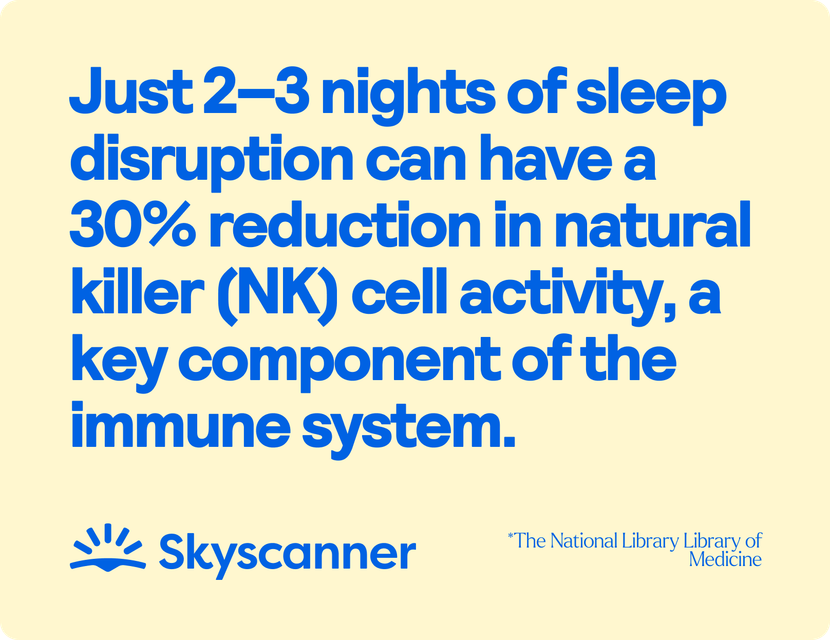
Have you ever noticed that you tend to catch a cold slightly more often after getting back from a long trip? Research shows that travelers experiencing sleep disruption for just 2–3 nights can have a 30% reduction in natural killer (NK) cell activity, a key component of the immune system.
This makes them more susceptible to infections such as colds or travel-related illnesses. Couple that with the amount of people you’ll be sharing a cabin with, and the chances of picking up a cold thanks to your jet lag go up.
14. Travel fatigue and jet lag can affect you at the same time
We’ve already briefly touched on the different kinds of symptoms that people will experience when they’re jet lagged, and one of them is a feeling of extreme tiredness. But did you know there’s also travel fatigue? While jet lag and its symptoms are strictly related to flying across timezones and how that affects your circadian rhythm, travel fatigue can happen after any long journey, including on a plane. Being in one seat for a long time can make you feel stiff, thinner air pressure than you’re used to means your body has to do more to stay at its normal level, and a lack of humidity can lead to dehydration. All of this adds to how exhausted you feel by the time you reach your destination.
15. Sleep duration tends to recover quickly
In encouraging news, the amount of time we sleep has been found to bounce back relatively fast. Oura found that the amount of sleep someone gets every night was able to rebound to within 12 minutes of their normal baseline within just two days of returning back to normal life at home. For savvy holidaymakers, that means building in a weekend after your trip to recover will see you in good shape by the time you head back to work on Monday.

16. Sleep routine takes a lot longer to bounce back
In less good news, your circadian rhythm and bedtime routine might take a bit longer to go back to normal. The same source said that those wanting to get back into their usual routine after a trip might have to wait anywhere up to 15 days before things began to gel properly again.
17. A lack of sleep can have a huge impact on wider mental health
The crux of the issue is that a lack of sleep brought on by jet lag can have a big effect on your overall mental health and wellbeing. In fact, research suggests that sleep deprivation can lead to a 9% variance in psychological wellbeing. That can have a huge impact beyond returning to normal sleep patterns, with it dragging into your day-to-day life.
18. Losing sleep can increase stress
The same research found that poor sleep quality can lead to increased levels of stress, irritability, anxiety and emotional dysregulation. Given that the sleep you might get on a plane isn’t the best, it’s no surprise that you might feel out of sorts when you land.
19. Sleep issues commonly precede periods of feeling low
What’s more, falling out of our circadian rhythm puts us in a position where we’re slightly more susceptible to other mental health and wellbeing issues. Hope Trust India suggests that lack of sleep can cause symptoms of anxiety or depression.
20. For some, travel actually means more chances to sleep
Interestingly though, jet lag isn’t always a factor for those who travel. In fact, in some cases the hop between timezones seems to have the opposite impact. A study by Jonasdottir, Bagrow and Lehmann has shown that those who might usually be classified as “underslept individuals” actually got more sleep while they were on their travels, whereas those who regularly got more than 7.5 hours a night tended to see their total hours of sleep dip.
21. The jet lag therapy market is now worth billions
A variety of techniques and preventative measures used to combat jet lag are often grouped together under the banner of “jet lag therapy”. This includes supplements, as well as light therapy. This market reached a whopping $441.1 million in 2024 (approximately ₹39.7 billion), having been rapidly driven forwards by the evolving use of technology and tools within the sleep management sector.
22. The market is expected to grow further in the future
And this looks like it’s only the beginning for the wider market. Forecasted figures show just how much of a factor the need to battle jet lag has become, with predictions from the folks who crunch the numbers suggesting that from 2025 through to 2033, the value of these transformative treatments and preventative measures is expected to grow at a rate of 3.73% per year. That would see the total value jump from $441.1 million (approximately ₹39.7 billion) to $619.3 million (approximately ₹55.8 billion) in that time.
23. Sleep tourism is an alternative which one in five people are now trying out
As if that wasn’t already enough, a lot of holidaymakers are now also taking the power of sleep back into their own hands. Sleep tourism is a new phenomenon where people are actively seeking out places to go and get the rest and relaxation they need as an intrinsic part of their time away. This isn’t surprising, given that research by Philips showed 93% of people in India aren’t getting enough sleep in their daily lives.
24. A lot of people will pay more for a sleep enhanced room
Such is the weight being placed on a good night’s rest, that travellers are willing to go as far as to pay more for a room which has been designed with enhancing the sleep experience in mind. Sleep tourism research found that 43% of respondents were willing to hand over more money to make sure that they weren’t going to see their overall sleep quality levels suffer. In total, it’s thought that those on a sleep tourism getaway were willing to spend an average of $1,752 (approximately ₹152,239).

25. Italy, Japan, Greece and the Maldives lead the way for sleep tourism
The best spots to try this revolutionary new form of tourism? Well, you’ll find them dotted all over the globe. From Asia to Africa, Europe to North America, there is a wide array of serene destinations which tourists looking for tranquil travel are trying out.
The previous study found that Kyoto in Japan ranks first, with 19% of respondents saying they’d give this historic cultural hub a try. The islands of Santorini in Greece (14%, the Amalfi Coast in Italy (13%), and the Maldives (11%) were the next most popular. When it came to North America, Big Sur in California led the way with 8% of responses, followed by its neighbour the Napa Valley (8%) and Arizona’s desert town of Sedona (7%).
26. The sleep tourism market is another which is expected to see major growth
Just like with the growing popularity of jet lag therapy, the market for sleep tourism looks ready to steamroll on. Many estimate as much as 12.4% of compound annual growth in the sector between now and 2030, with its total value rising to $148.98 billion (approximately ₹13.4 trillion) in that time if those figures turn out to be correct.
13 ways you can prevent jet lag from becoming a factor on your trip
Now that you’ve got a better grasp of how and why jet lag can have such an impact on a trip away, it’s time to take the power back. While there’s no guaranteed way to make sure jet lag doesn’t impact you in some capacity, there are plenty of tricks to help reduce that unwanted feeling of lethargy or grogginess. Here are some actionable tips to try when you’re next travelling on a long haul flight.
1. You can prevent jet lag by sleeping earlier before travel
Our first snippet of advice is to gradually adjust your sleep schedule prior to the date of your trip. This doesn’t have to be anything dramatic. Something as simple as going to bed 15 minutes earlier (if you’re headed east) or later (if you’re going west) every night for around two weeks prior to your trip will have a big impact. Also think about doing the same thing when it comes to when you eat. Getting your circadian rhythm in line with your new timezone can mitigate several potential hours of lost sleep.
2. Consider arriving a few days early, or building in rest days
If you’re going away with a specific purpose in mind, such as a business meeting or to attend an event, planning to arrive a little before the time you need to is another smart idea. Most of the more extreme symptoms of jet lag will slowly wear off after a few days in a new timezone, which gives you a window to turn up, get to grips with them, then start to feel more like yourself again in time for the main purpose of your trip. If there isn’t a specific event you’ve travelled for, these extra days will still give you a chance to guarantee you’re experiencing your holiday to its fullest.
3. Manage your bright light exposure
We’ve already discussed how getting too much exposure to light can keep you awake when you might want to sleep. But, naturally, the opposite can also be true. Even just getting outside for up to 15 minutes (or longer if you have a darker skintone) can help provide enough vitamin D and melatonin suppression to make sure you’re feeling awake enough to take on the day.
4. Staying hydrated can reduce the impact of jet lag
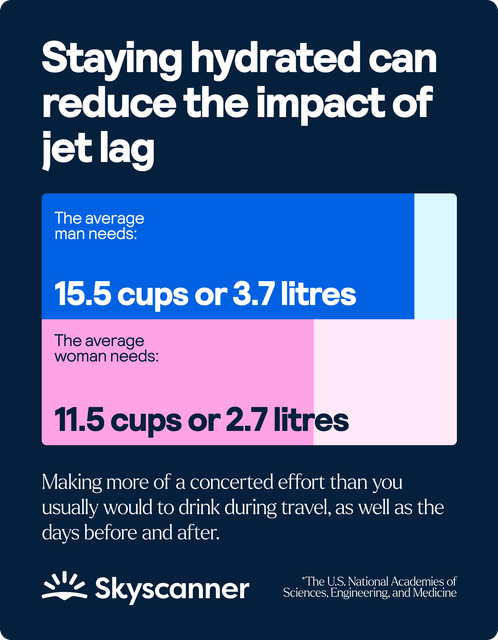
Keeping up your hydration levels is another way to make sure you’re doing what you can to stave off some of the more challenging symptoms. It’s thought that the average human man needs about 15.5 cups (or 3.7 litres) of water a day to keep their body functioning at top capacity, while a woman needs 11.5 cups (2.7 litres). Making more of a concerted effort than you usually would to drink during travel, as well as the days before and after. If it helps, you can set reminders to drink every hour or so.
5. Avoid alcohol
A glass of alcohol with your meal on the plane might sound like a good idea, but you’re not helping yourself in the long run. Alcohol interferes with your sleep cycle – you may well doze off more quickly, but the quality of sleep you’re getting will be worse.
6. Choose lighter meals
As well as staying hydrated, it’s important to be aware of what you’re eating while on the plane. Heavy meals can cause disruption to digestion, and the time that you eat helps establish your body clock. Constantly snacking can also be an issue, as it makes it harder for your body to understand what time it is. While you won’t have control over the serving times on the plane, opting for lighter choices where possible can be a good idea.

7. Change your watch before you travel
While it won’t have the same impact from a physical perspective, changing your watch to the timezone you’re travelling to can help to make the transition between them a little easier. Starting this a few days before you travel will also give you a rough idea of what your body feels like during times when you might need to eat or sleep in your travel destination. You can find the timezone you’ll be visiting online.
8. Keep moving on the plane
It can be tempting to stay in your seat as much as possible when flying, especially if you’re flying at night. However, getting up and moving around every couple of hours, or doing some exercises in your seat such as ankle rolls and seated twists, can help ward off fatigue and help you adjust your body clock.
9. Consider an app which helps to prevent jet lag
More awareness than ever exists around how and why we need to battle jet lag. As a result, there are now plenty of apps which exist to make drifting off to the land of nod faster than ever before. And there’s a clear keenness from travellers – particularly those flying for business – to adopt their usage. A recent report found that 69% of people travelling for this reason were either already using these kinds of apps, or intended to start using them in the future.
10. Try not to nap for too long when you arrive (particularly eastwards)
It might be tempting to catch a little shut eye when you travel (especially if you’re moving eastwards, where your body will feel like you’ve lost sleep). But doing this can actually keep your internal clock out of rhythm for longer. If you feel like you absolutely have to sleep, try to cap it at 15-to-30 minutes at maximum.
11. Melatonin has emerged as one remedy for those unable to sleep on their travels
We’ve already discussed how melatonin plays a big role in the ease with which we fall asleep. If you find that you’re struggling to drift off, it’s now possible to buy melatonin supplements which can make falling asleep faster. 78.4% of respondents in a recent study said that using the hormone supplement helped them, with it having a peak impact on them after roughly one hour after usage. Just be aware that melatonin use may not be recommended if you have certain health conditions, or take other medications. It’s always best to consult a health professional.
12. Tasimelteon is another alternative
An alternative to melatonin is the supplement tasimelteon. This was found to increase total sleep time in participants of a study by as much as 85 minutes per night. It was also found to improve next-day alertness (the time it took to wake up and feel ready to face the day) by as much as 15 minutes.
13. Light therapy can also battle jet lag
Light therapy is another option for those wanting to improve sleep time. While this is more useful after returning from a trip, it still plays an important role in making sure sleep patterns return to healthy levels. The process sees the use of special light boxes, or dawn simulators, which can help to trigger the body’s ability to manage its own circadian rhythms.
Do you feel like you understand more about jet lag and how you might beat it? Enjoying your holiday is the most important part of any time away, so allowing sleep deprivation and other feelings of discomfort to get the best of you simply can’t be allowed. Use this resource as your guidepost for understanding the causes, symptoms, cures and preventative measures associated with jet lag, then kick back and thoroughly enjoy your holiday. You’ve earned it.


