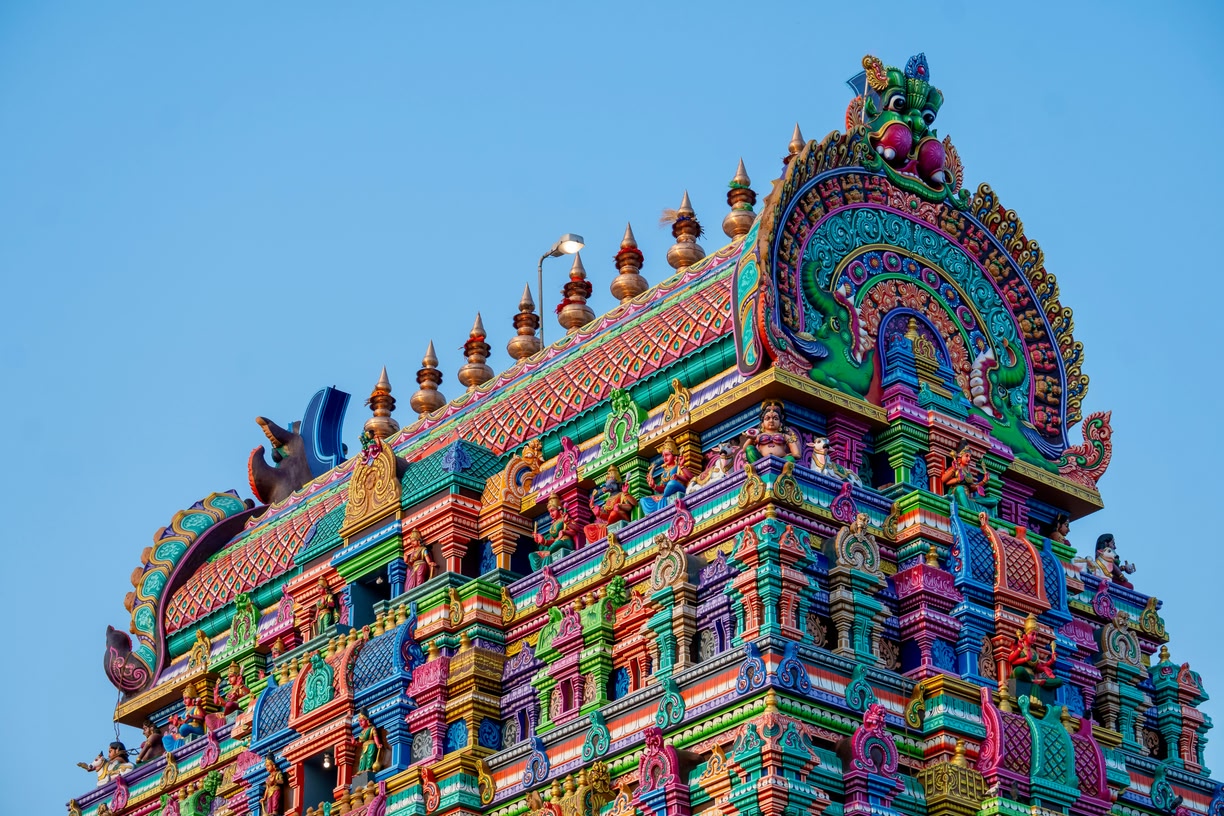
From Lord Rama's birthplace in Ayodhya to the legendary kingdom of Lanka, discover the sacred places and cultural landmarks of the Ramayana across Asia.
Nitesh Tiwari's upcoming interpretation of the Ramayana will be a two-part adaptation, starring some of Indian cinema's biggest names, including Ranbir Kapoor as Lord Rama and Sunny Deol as Lord Hanuman. Set to be one of the most expensive productions in Indian cinema history, the film brings together international talent, including the Oscar-winning visual effects studio DNEG, whose credits include Christopher Nolan's The Odyssey, and legendary composers A.R. Rahman and Hans Zimmer. With the first part scheduled for release in cinemas on 5 November 2026, just ahead of Diwali, the beloved story is set to return to the big screen in a spectacle of epic proportions.
However, the Ramayana has been part of India's cultural and spiritual heritage for generations. We're all familiar with the story of Lord Rama's 14-year exile, Sita Ma's abduction by Ravana, the battle in Lanka and the triumphant return to Ayodhya. What we're less familiar with, however, are the real places associated with the Ramayana.
Beyond its lessons of dharma, devotion and the triumph of good over evil, the epic has left its mark on landscapes across India and beyond. From the temples of Ayodhya and the forests of Chitrakoot to the sacred shores of Rameswaram, many places associated with Lord Rama's journey remain important pilgrimage destinations today.
The Ramayana's influence also extends far beyond India, through ancient carvings in Cambodia, traditional dance performances in Indonesia and Thailand's colourful temple murals. This guide details the places from the epic itself, and those that have been shaped by its enduring legacy.
Where was the new Ramayana film filmed?
Most of Nitesh Tiwari's Ramayana has been filmed in Mumbai’s Film City, though a small number of battle sequences were filmed on-location at Aksa Beach on Mumbai's western coastline.
Film City, Mumbai, India
Located in Goregaon, Mumbai's Film City has provided filming locations for many of Bollywood's best-known productions, including Sholay and Dilwale Dulhania Le Jayenge. Elaborate sets were also constructed here for Ramayana, including palace courtyards and royal balconies recreating the kingdom of Mithila, where Rama and Sita's marriage story unfolds. While Film City offers organised visitor tours, access to individual production sets is restricted. So, you might not be able to step onto the sets behind Ramayana, but you can get a glimpse of Bollywood's movie-making magic. Depending on the tour and ongoing productions, visitors may see standing sets resembling temples, village streets, police stations and railway stations, alongside the landscaped gardens and lakes that have provided backdrops for countless films and television programmes.
Aksa Beach, Mumbai, India
On Mumbai's western coastline, Aksa Beach was reportedly used for battle sequences featuring Ravana. While production relied on green-screen technology and visual effects, visitors can still enjoy broad stretches of sand and views across the Arabian Sea, offering a quiet respite from the hustle and bustle of Mumbai. Do keep in mind though, swimming is not recommended here due to dangerous currents.
Places to visit from the Ramayana
While the new film recreates much of the epic's world through elaborate sets and visual effects, the best way to experience the Ramayana is on the ground. From the birthplace of Lord Rama to the forests of his exile and the shores associated with the crossing to Lanka, these destinations continue to attract devotees and travellers seeking to connect with the epic's enduring legacy.

Ayodhya, Uttar Pradesh
Where the story starts and ends
Ayodhya is the traditional birthplace of Lord Rama, and where the epic ends after his long-anticipated homecoming following 14 years of exile. Visitors to the city can visit Ram Mandir built at the site traditionally revered as Lord Rama's birthplace, and also observe one of India’s major festivals in full-blown glory. The city is also closely associated with Diwali, which celebrates Lord Rama and Sita Ma's return to Ayodhya. Each year, the festival brings the story to life, with vast numbers of oil lamps illuminating the banks of the Sarayu River. Nearby, Hanuman Garhi is a hilltop temple dedicated to Lord Hanuman, the devoted ally who helps Lord Rama rescue Sita Ma. According to local tradition, Lord Hanuman remained in Ayodhya to guard the kingdom following Lord Rama's return. Today, visitors can climb 76 steps to reach the temple.

Janakpur, Nepal
Where Lord Rama wins Sita Ma's hand in marriage
The next major chapter of the story takes us to Mithila, the kingdom of King Janaka, where Lord Rama arrives for Sita Ma's swayamvara. King Janaka has declared that whoever can lift and string the enormous bow of Lord Shiva will marry his daughter. None of the other suitors can manage the feat, but Lord Rama not only lifts the bow with ease, he breaks it as he draws the string, demonstrating his extraordinary strength, thus securing his marriage to Sita Ma. The marriage is still celebrated in Janakpur during the annual Vivah Panchami festival, when processions and wedding ceremonies recreate the royal union and visitors can explore the pavilion which marks the place where the deities are believed to have married. Also nearby is Janaki Mandir, a richly decorated temple dedicated to Sita Ma, whose white façades, domes and intricate details make it one of the city's most distinctive buildings.

Chitrakoot, in-between Uttar Pradesh and Madhya Pradesh
The forests of Lord Rama's exile
After Lord Rama is exiled from Ayodhya, he leaves behind royal life and travels into the forest with Sita Ma and his brother, Lakshmana. Their journey brings them to Chitrakoot, a peaceful landscape of wooded hills and rivers, where they settle during the early years of their exile. Chitrakoot becomes the setting for one of the Ramayana's most significant encounters. Lord Rama's younger brother, Bharata travels from Ayodhya to persuade him to return and take his rightful place as king. Rama refuses, determined to complete the 14 years of exile. Instead, Bharata takes Rama's sandals back to Ayodhya and places them on the throne, to signify that he will rule on his brother's behalf until his rightful return. Today, visitors can explore Bharat Milap Temple, traditionally associated with the brothers' reunion. The temple is situated along the pilgrimage route around Kamadgiri Hill, where Lord Rama, Sita Ma and Lakshmana are believed to have lived during their exile.

Hampi, Karnataka
The kingdom of Lord Hanuman
Few places capture the extraordinary landscapes of the Ramayana quite like Hampi. Along the banks of the Tungabhadra River, enormous granite boulders rise between ancient temples and ruined palaces. This landscape is traditionally associated with Kishkindha, the kingdom of the vanaras, the forest-dwelling simian army of which Lord Hanuman belongs to, who become Rama's allies in the search for Sita Ma. Here, Lord Rama meets Lord Hanuman, who introduces him to Sugriva, the exiled ruler of Kishkindha. Lord Rama helps Sugriva reclaim his throne from his brother Vali, and in return, Sugriva pledges his army to help Lord Rama in his quest. Lord Hanuman leads the search that eventually takes him to Lanka, where he discovers Sita Ma's whereabouts. Across the river from Hampi is Anjanadri Hill, the birthplace of Lord Hanuman. Visitors can climb the steps to its hilltop temple for panoramic views over the rocky landscape associated with the legendary kingdom. Outside of the realm of the Ramayana, Hampi's UNESCO-listed ruins tell of its history as the capital of the Vijayanagara Empire, one of southern India's great medieval kingdoms. Visitors can explore Virupaksha Temple, the intricate carvings of the Vittala Temple complex and the remains of the Royal Enclosure.

Rameswaram, Tamil Nadu
The journey across to Lanka
Rameswaram is an island off the coast of Tamil Nadu in South India, separated from Sri Lanka by a narrow stretch of sea. According to the Ramayana, Lord Rama's army builds a bridge across the water to reach the kingdom of Lanka, to confront Ravana and rescue Sita Ma. The crossing is traditionally associated with Ram Setu, also known as Adam's Bridge, a chain of limestone shoals extending between India's Pamban Island and Sri Lanka's Mannar Island. Rameswaram is also home to Ramanathaswamy Temple, one of Hinduism's most important pilgrimage sites, Here, it is said that Lord Rama prayed to the god Shiva following his victory over Ravana, though some believe he prayed to Lord Shiva here before travelling to Sri Lanka. Nearby, Dhanushkodi offers views across the narrow waters towards Sri Lanka, close to the legendary crossing described in the epic.

Nuwara Eliya and Gurulupotha, Sri Lanka
The search for Sita Ma begins
After Sita Ma's abduction, Ravana takes her to his kingdom of Lanka, where she remains captive while Lord Rama and his allies search for her. Several sites traditionally associated with her captivity now form part of Sri Lanka's Ramayana Trail. For example, according to local traditions, Sita Ma was initially held in a palace belonging to Ravana's wife, Mandodari, in a forested area near present-day Gurulupotha, known as Sita Kotuwa, meaning Sita's Fort. While the palace is no longer in existence, visitors can reach the site of the fort via a forest walking trail, with the surrounding waterfalls, streams and dense vegetation. Sita Ma is later moved to Ashoka Vatika, a garden within Ravana's kingdom, where Lord Hanuman eventually finds her. In present-day Nuwara Eliya, Seetha Amman Temple is associated with that same garden, where it's said markings on nearby rocks are footprints left by Lord Hanuman. Beyond the Ramayana connections, Sri Lanka's central highlands offer tea plantations, waterfalls and mountain scenery, making the region a rewarding destination in its own right.
How the Ramayana travelled around the world
Lord Rama's journey may end in Ayodhya, but the Ramayana's influence extends far beyond India.
Over centuries, the epic has travelled throughout Asia and along the way, characters and events have been reinterpreted to create distinctive versions of the story as it has integrated with local literature, sculpture, theatre, dance and art.
Today, some of the most striking places to experience the Ramayana are found far from the geographical setting of the original epic.

Bangkok, Thailand
In Thailand, the Ramayana became reinterpreted as the Ramakien, a national epic that adapts the Indian story through Thai literary, artistic and religious traditions. Its legacy is visible at Wat Phra Kaew, the Temple of the Emerald Buddha, within Bangkok's Grand Palace complex. Here, an extensive series of colourful murals depicts scenes from the Ramakien, with royal processions, elaborate palaces and great battles unfolding across the gallery walls. The murals offer a striking example of how the story evolved as it moved across Asia as familiar characters take on distinctive Thai identities, including Phra Ram, the counterpart of Rama, and Thotsakan, the ten-headed ruler corresponding to Ravana.

Siem Reap, Cambodia
Built originally as Hindu temple, Cambodia's Angkor Wat, depicts scenes from the Ramayana, most notably, scenes from the Battle of Lanka, across elaborate stone-wall carvings of the now Buddhist complex. On the temple's western galleries, visitors can see Lord Rama's forces confronting Ravana's army in a crowded battle scene of warriors, animals and supernatural beings, all carved into the sandstone. The epic also influenced Cambodia's own Reamker, a Khmer adaptation that became an important part of the country's literary and performing arts traditions.

Yogyakarta, Indonesia
In Indonesia, the Ramayana has been preserved not only in ancient temple carvings but through centuries of storytelling, music and dance. One of the most memorable places to experience it is Prambanan, a ninth-century Hindu temple complex near Yogyakarta. Its stone reliefs depict scenes from the Ramayana, allowing visitors to follow the story as they walk around the temple galleries. The epic takes on another form in the Ramayana Ballet, a traditional dance-drama performed to Javanese gamelan music, an ensemble of percussion instruments including gongs and xylophones. Through elaborate costumes, expressive movements and music, dancers bring the story of Rama and Sita to life without spoken dialogue. Between May and October, performances take place at an open-air theatre, with Prambanan's illuminated temples providing a spectacular backdrop. Indoor performances are staged during the wetter months, allowing visitors to experience the story throughout the year.


